


4 years ago
Showing posts with label sustainability. Show all posts
Showing posts with label sustainability. Show all posts
Thursday, December 11, 2008
Shigeru Ban
Innovative design from one of my favorite architects. Shigeru Ban and the Pompidou Metz was the subject of my senior thesis.
Friday, October 03, 2008
"What we do here affects the rest of the world. People follow."

Thursday, February 01, 2007
Guess what!
I've been neglecting this little blog because I've been working on another blog (see previous entry) . That blog has been part of a competition entry for a design conference called Tasmeem. The competition is to identify an issue dealing with water and generate design solutions for the problem. I worked on the project with a friend and we focused on the 1.2 billion people who don't have access to a source of clean drinking water and the 6,000 children who die every day from a water-borne illness. It's a little outside the realm of interiors, but it was fun to apply what I've learned to another area of design.
I just found out that we won! The prize is all expense paid trip toQatar
Yes, that's right! I'm going to Qatar! Where in the world is Qatar?! Here it is:

Yes, I know. It's in the Middle East. But the safe part of the Middle East. I promise.
Qatar has mosques . . .

. . . and luxury resorts . . .

. . . and camels . . .

. . . and this giant pearl.
 It is also the home of Virginia Commonwealth University in Qatar who is sponsoring our visit.
 I'm so excited!
I just found out that we won! The prize is all expense paid trip to
Yes, that's right! I'm going to Qatar! Where in the world is Qatar?! Here it is:

Yes, I know. It's in the Middle East. But the safe part of the Middle East. I promise.
Qatar has mosques . . .

. . . and luxury resorts . . .

. . . and camels . . .

. . . and this giant pearl.
 It is also the home of Virginia Commonwealth University in Qatar who is sponsoring our visit.
 I'm so excited!
Tuesday, January 02, 2007
Experiment
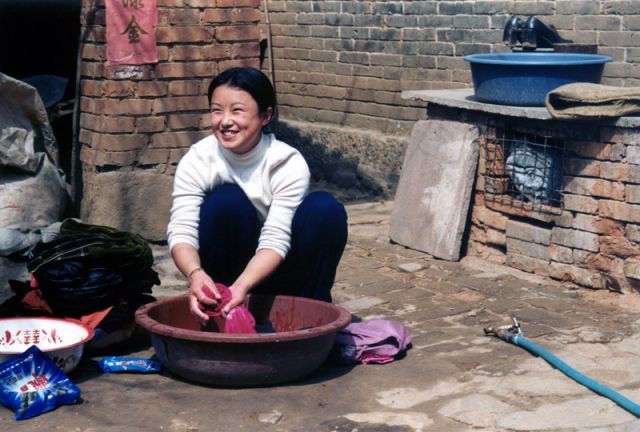
I'm starting a blogging experiment. I want a blog to save the world.
We all know the power that blogs have to bring people together, people who would never have met otherwise. Blogs can entertain and inform and shape our lives in unexpected ways. I want to take this power and use a blog to help those who need it most.
Over 1.1 billion people in the world, right now, don't have access to a clean source of drinking water. Children are hurt the most - 1.5 million children under the age of five die every year from water-born diseases. Every one of these deaths is preventable.
Just by having access to a computer puts every one of us in a position of great privilege and power. What will you do with that power?
I want to do something, so I'm starting another blog to explore what we can do to address this global crisis. We are all affected by the way water is used and misused, whether we realize it or not. My new blog will be a discussion of what we can do. I don't know what form it will take. It is something that I hope will start a discussion and grow as we try to figure this out together.
So please visit Water Is . . . I chose that title because water is so many things, to so many people. Water is hope, it is freedom, it is power, it is life. I will update it daily, so check back and help me find ways to make it fun, as well as informative. Together we can save the world, even if it is for one person.
Wednesday, November 01, 2006
Design Crisis
I found this quote on a forum at Design Community.
Of course the next question is, "What is design?"
"In many ways, the environmental crisis is a design crisis. It is a consequence of how things are made, buildings are constructed, and landscapes are used. Design manifests culture, and culture rests firmly on the foundation of what we believe to be true about the world."This reminds me of one of my favorite quotes by Bruce Mau.
— Sim Van der Ryn, quoted in The Philosophy of Sustainable Design, by Jason McLennan
"What if we could do anything? What if the questions surrounding design turned out to be the big questions? What if life itself became a design project? What if - as Arnold Toynbee once suggested - we were committed to an audacious, altruistic global project that imagined 'the welfare of the entire human race as a practical objective'? What if design turned out to be that project? What if we succeeded?"The thought of "the welfare of the entire human race" as a practical design objective is intriguing. If it were true, then there is a corollary. Most of society's problems have been caused by bad design. If the problem is bad design, then the solution lies in good design. What if saving the world is easier than anyone realises?
Of course the next question is, "What is design?"
Tuesday, June 20, 2006
The Key to Success
"No matter how efficient a building is with its resources, if you don't inspire the community, it will get torn down and thrown away. We can't just be considering if it's good for the earth. We have to think: Is it good for the people?"
-Linda Burnett, "Sustain Me," Contract Magazine, April 2006 p. 60
Monday, May 29, 2006
Sustainability: Building Materials
Assignment 1: Royal American Design Program
 What is sustainability and how does it relate to your field and interests?
The internationally accepted definition of sustainability was established by the UN's World Commission on Environment and Development in 1987. It is, "development which meets the needs of the present without compromising the ability of future generations to meet their own needs". 1 It's a nice, concise definition, but it's too vague to really mean much.
The 2006 AIA convention held last week discussed adopting the following definition for sustainability:
The most intriguing aspect of sustainability for me is the balance between the environment, the economy, and social issues. That is where traditional environmental movements have failed and where sustainable development has a chance at succeeding. None of this is possible without the economic benefits of business and the greatest strides have come from companies who embrace sustainability as part of their corporate social responsibility.
What are the problems that need to be solved with my team topic and sustainability?
Building materials make up the largest amount of material used in a project. They have the biggest impact on the cost and take the largest toll on the environment. The biggest contribution to LEED certification is also found in building materials. This is the worst problem we face:

Buildings need to be designed and built so that they will either last for 100s of years (as in Europe), or be dismantled and upcycled at the end of their lifecycle. All of this ended up at the landfill and it was an incredible waste of materials. The old Merrill Library should have been designed to have a much longer lifespan. It only took 40 odd years to become dangerous and obsolete.
The reality of suburban America is disposable architecture. WalMart and the rest don't care what happens to their buildings when they close a store. If a big box becomes rundown a company will tear it down and rebuild before it will consider a permanent presence in a community it may not survive in. Look at Brigham City. WalMart will build a new monster store before it will convert the empty Fred Meyer, Kmart and ShopKo buildings. What happens if WalMart needs to close? Brigham will be left with another dead store and sprawl that is threatening the downtown district. Logan isn't in much better shape. What will happen if the new WalMart on the south end of town closes? What happens to the Macey's building when they build their new location? What if ShopKo or Kmart close? The companies cut their losses and leave while the community is left with the reprecussions of bad planning and bad building.
As many of us heard at NeoCon West, Karim Rashid spoke of the virtue of disposable architecture. He believes a building should be meant to last a set period of time, maybe 10 or 20 years, and then torn down to be replaced with something better. The average lifespan of a casino in Las Vegas is 30 years. If this is the future then sustainability is more vital than ever. William McDonough's Cradle to Cradle philosophy must be embraced if we are going to tear down and rebuild. A maximum amount of building materials must be designed to be upcycled and waste really must equal food. If not we will eat ourselves alive. What will Cache Valley look like in 100 years?
What solutions are currently out there?
 The May 2006 issue of W Magazine has an article about architect David Hertz. He is a hot property among LA celebrities for his innovative approach to green design. Hertz began his career as Frank Gehry's intern and works closely with Paul Hawken, author of The Ecology of Commerce. His current project is a home constructed from the shell of an old 747. He is the inventor of Syndecrete, "an innovative pre-cast lightweight concrete architectural surfacing material which incorporates recycled aggregates extracted from society’s waste stream." 3 Everything from glass to crushed vinyl records can be mixed in Syndecrete, which is liscenced through Interface. 4 Solutions come from innovative people like Hertz who see a problem and find a solution.
Other solutions (and their own problems):
Dimensional lumber is the wood used to construct most homes. Wood is renewable, but the amount we use is straining our resources and affecting our water, soil and air quality. Forestry Stewardship Council (FSC) certified wood is grown in managed forests that meet strong ecologically based standards. The problem is that there are few managed forests and not many bodies who certify them. It is also difficult to identify old growth wood once it has been harvested. The best solution comes from using regionally grown wood where the supply and demand could be easily monitored, and the local economy could recieve the greatest benefit. 5
Forest Stewardship Council
Forest Stewardship Council International
Sustainable Lumber Production
Illegal Logging
Profile Lumber
AltruWood
Full Cycle WoodWorks
Engineered wood is made from laminating wood chips together and uses recycled and reconstituted wood material. It is stronger and strighter than lumber, and easier to work with when spanning longer distances. These products, like plywood, dramatically reduce waste. 6 The problem with engineered wood is that the resin used to bind the wood fiber together is made from formaldehyde and other toxic chemicals that will offgass into the air for decades. Formaldehyde is a probable know carcinogen, as are xylene and toulene, other chemicals commonly used in the manufacturing process. For engineered wood to be considered sustainable it must use formaldehyde-free and non-toxic binders. There are some products that can minimize this problem by sealing the wood. The health effects caused by these chemicals are significant and contribute to poor indoor air quality and sick building syndrome. Other sheet materials can be made from recycled newsprint, agicultural byproducts (wheatboard), and recycled gypsum, but the same caution must be taken to make sure they don't use toxic binders.
APA The Engineered Wood Association
Engineered Structural Products
Wheatboard
Strawboard
Woodstalk
Concrete is usually made from manufacturing byproducts and is considered sustainable. Once cured it is stable and doesn't offgass. Flyash is the waste residue caused by burning coal in electrical plants. Thirteen million tons of flyash is produced each year in Texas alone. When flyash is recyled by mixing it into concrete it imporves its workability and increases strength. It also reduces the corrosion caused be reinforcing steel. Flyash concrete is identical in cost to standard concrete. 7
Development of Green Cement
Sustainable Concrete
Sustainable Concrete Structures
Concrete International
Glass is a low emissions material that can contribute to sustainability in several areas. It can be easily recycled and made into many interior finishes. It is available with coatings that deflect sunlight, reducing heating and the cost of air conditioning. 8 Skylights let in natural light and reduce the amount of artificial light needed. Notice the use of natural light vs florescent lighting in the new Merrill-Cazier Library. This picture was taken in the basement.

Advanced Glass Group
Daylighting Collaborative
Daylighting
Daylighting in Schools Improves Student Performance
Recycled Glass Products
Steel provides a flexible building system that is easily modifiable for future use. This extends the building's lifecycle as future tenants can adapt the space for their own needs. Steel can be easily dismantled and reused or recycled without degrading its quality. Steel is manufacured off site by skilled laborers who are paid well and enjoy higher workplace safety than other industries. The steel industry, especially in Europe, has identified several areas that can contribute to sustainability. These topics include: environmental reporting, training responsible contractors, and developing new products that meet the needs of sustainable goals. 9
ISSI World Steel Industry
Sustainable Steel Construction
Sustainable Steel Roofing
Canadian Steel Buildings Case Studies
What areas need more exploration around your team topic?
We need new alternatives to conventioan building materials that are practical and cost effective. There must be more people like David Hertz who are coming up with solutions that haven't hit the mainstream. Research needs to be done to find alternative materials, to identify areas that need further development, and to find creative uses for existing materials.
What conclusions have you found, specifically that you would like to take on personally?
I'm interested in cost analysis. The perception is that sustainable design is much more expensive. What exactly does it cost compared to conventional building, and at what point will it pay for itself? Cost is the biggest concern to the client.
Sources:
1. http://www.gdrc.org/sustdev/definitions.html
2. "Draft Definition of Sustainable Design", May 24, 2006 http://architectureofsustainability.blogspot.com/
3. http://www.volume5.com/html/david_hertz_architect.html
4. http://www.ema-online.org/greenlight_2003_spring_green_remodeling.htm
5. http://www.greenbuilder.com/sourcebook/DimensionalLumber.html
6. http://www.greenbuilder.com/sourcebook/EngStruct.html
7. http://www.greenbuilder.com/sourcebook/Flyash.html
8. http://www.designcommunity.com/discussion/23872.html
9. http://scinews.steel-sci.org/articles/pdf/SSC.pdf
"Like any good design, good sustainable design demands informed, caring, diligent, and creative work."- John Morris Dixon, FAIA
May 2006"What if we could do anything? What if the questions surrounding design turned out to be the big questions? What if life itself became a design project? What if - as Arnold Toynbee once suggested - we were committed to an audacious, altruistic global project that imagined "the welfare of the entire human race as a practical objective"? What if design turned out to be that project? What if we succeeded?"-Bruce Mau
 What is sustainability and how does it relate to your field and interests?
The internationally accepted definition of sustainability was established by the UN's World Commission on Environment and Development in 1987. It is, "development which meets the needs of the present without compromising the ability of future generations to meet their own needs". 1 It's a nice, concise definition, but it's too vague to really mean much.
The 2006 AIA convention held last week discussed adopting the following definition for sustainability:
The linked domains of sustainability are environmental (natural patterns and flows), economic (financial patterns and equity), and social (human, cultural, and spiritual). Sustainable design is a collaborative process that involves thinking ecologically—studying systems, relationships, and interactions—in order to design in ways that remove rather than contribute stress from systems. The sustainable design process holistically and creatively connects land use and design at the regional level and addresses community design and mobility; site ecology and water use; place-based energy generation, performance, and security; materials and construction; light and air; bioclimatic design; and issues of long life and loose fit. True sustainable designs are beautiful, humane, socially appropriate, and restorative of natural systems. 2I love this definition. It is everything I want design to be. I chose my internship at GSBS because their focus is on sustainable architecture. I'm in an office full of LEED APs, and it is my goal to be LEED accredited by the time I graduate next spring.
The most intriguing aspect of sustainability for me is the balance between the environment, the economy, and social issues. That is where traditional environmental movements have failed and where sustainable development has a chance at succeeding. None of this is possible without the economic benefits of business and the greatest strides have come from companies who embrace sustainability as part of their corporate social responsibility.
What are the problems that need to be solved with my team topic and sustainability?
Building materials make up the largest amount of material used in a project. They have the biggest impact on the cost and take the largest toll on the environment. The biggest contribution to LEED certification is also found in building materials. This is the worst problem we face:
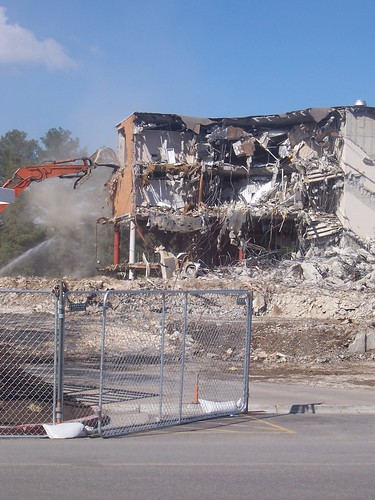
Buildings need to be designed and built so that they will either last for 100s of years (as in Europe), or be dismantled and upcycled at the end of their lifecycle. All of this ended up at the landfill and it was an incredible waste of materials. The old Merrill Library should have been designed to have a much longer lifespan. It only took 40 odd years to become dangerous and obsolete.
The reality of suburban America is disposable architecture. WalMart and the rest don't care what happens to their buildings when they close a store. If a big box becomes rundown a company will tear it down and rebuild before it will consider a permanent presence in a community it may not survive in. Look at Brigham City. WalMart will build a new monster store before it will convert the empty Fred Meyer, Kmart and ShopKo buildings. What happens if WalMart needs to close? Brigham will be left with another dead store and sprawl that is threatening the downtown district. Logan isn't in much better shape. What will happen if the new WalMart on the south end of town closes? What happens to the Macey's building when they build their new location? What if ShopKo or Kmart close? The companies cut their losses and leave while the community is left with the reprecussions of bad planning and bad building.
As many of us heard at NeoCon West, Karim Rashid spoke of the virtue of disposable architecture. He believes a building should be meant to last a set period of time, maybe 10 or 20 years, and then torn down to be replaced with something better. The average lifespan of a casino in Las Vegas is 30 years. If this is the future then sustainability is more vital than ever. William McDonough's Cradle to Cradle philosophy must be embraced if we are going to tear down and rebuild. A maximum amount of building materials must be designed to be upcycled and waste really must equal food. If not we will eat ourselves alive. What will Cache Valley look like in 100 years?
What solutions are currently out there?
 The May 2006 issue of W Magazine has an article about architect David Hertz. He is a hot property among LA celebrities for his innovative approach to green design. Hertz began his career as Frank Gehry's intern and works closely with Paul Hawken, author of The Ecology of Commerce. His current project is a home constructed from the shell of an old 747. He is the inventor of Syndecrete, "an innovative pre-cast lightweight concrete architectural surfacing material which incorporates recycled aggregates extracted from society’s waste stream." 3 Everything from glass to crushed vinyl records can be mixed in Syndecrete, which is liscenced through Interface. 4 Solutions come from innovative people like Hertz who see a problem and find a solution.
Other solutions (and their own problems):
Dimensional lumber is the wood used to construct most homes. Wood is renewable, but the amount we use is straining our resources and affecting our water, soil and air quality. Forestry Stewardship Council (FSC) certified wood is grown in managed forests that meet strong ecologically based standards. The problem is that there are few managed forests and not many bodies who certify them. It is also difficult to identify old growth wood once it has been harvested. The best solution comes from using regionally grown wood where the supply and demand could be easily monitored, and the local economy could recieve the greatest benefit. 5
Forest Stewardship Council
Forest Stewardship Council International
Sustainable Lumber Production
Illegal Logging
Profile Lumber
AltruWood
Full Cycle WoodWorks
Engineered wood is made from laminating wood chips together and uses recycled and reconstituted wood material. It is stronger and strighter than lumber, and easier to work with when spanning longer distances. These products, like plywood, dramatically reduce waste. 6 The problem with engineered wood is that the resin used to bind the wood fiber together is made from formaldehyde and other toxic chemicals that will offgass into the air for decades. Formaldehyde is a probable know carcinogen, as are xylene and toulene, other chemicals commonly used in the manufacturing process. For engineered wood to be considered sustainable it must use formaldehyde-free and non-toxic binders. There are some products that can minimize this problem by sealing the wood. The health effects caused by these chemicals are significant and contribute to poor indoor air quality and sick building syndrome. Other sheet materials can be made from recycled newsprint, agicultural byproducts (wheatboard), and recycled gypsum, but the same caution must be taken to make sure they don't use toxic binders.
APA The Engineered Wood Association
Engineered Structural Products
Wheatboard
Strawboard
Woodstalk
Concrete is usually made from manufacturing byproducts and is considered sustainable. Once cured it is stable and doesn't offgass. Flyash is the waste residue caused by burning coal in electrical plants. Thirteen million tons of flyash is produced each year in Texas alone. When flyash is recyled by mixing it into concrete it imporves its workability and increases strength. It also reduces the corrosion caused be reinforcing steel. Flyash concrete is identical in cost to standard concrete. 7
Development of Green Cement
Sustainable Concrete
Sustainable Concrete Structures
Concrete International
Glass is a low emissions material that can contribute to sustainability in several areas. It can be easily recycled and made into many interior finishes. It is available with coatings that deflect sunlight, reducing heating and the cost of air conditioning. 8 Skylights let in natural light and reduce the amount of artificial light needed. Notice the use of natural light vs florescent lighting in the new Merrill-Cazier Library. This picture was taken in the basement.

Advanced Glass Group
Daylighting Collaborative
Daylighting
Daylighting in Schools Improves Student Performance
Recycled Glass Products
Steel provides a flexible building system that is easily modifiable for future use. This extends the building's lifecycle as future tenants can adapt the space for their own needs. Steel can be easily dismantled and reused or recycled without degrading its quality. Steel is manufacured off site by skilled laborers who are paid well and enjoy higher workplace safety than other industries. The steel industry, especially in Europe, has identified several areas that can contribute to sustainability. These topics include: environmental reporting, training responsible contractors, and developing new products that meet the needs of sustainable goals. 9
ISSI World Steel Industry
Sustainable Steel Construction
Sustainable Steel Roofing
Canadian Steel Buildings Case Studies
What areas need more exploration around your team topic?
We need new alternatives to conventioan building materials that are practical and cost effective. There must be more people like David Hertz who are coming up with solutions that haven't hit the mainstream. Research needs to be done to find alternative materials, to identify areas that need further development, and to find creative uses for existing materials.
What conclusions have you found, specifically that you would like to take on personally?
I'm interested in cost analysis. The perception is that sustainable design is much more expensive. What exactly does it cost compared to conventional building, and at what point will it pay for itself? Cost is the biggest concern to the client.
Sources:
1. http://www.gdrc.org/sustdev/definitions.html
2. "Draft Definition of Sustainable Design", May 24, 2006 http://architectureofsustainability.blogspot.com/
3. http://www.volume5.com/html/david_hertz_architect.html
4. http://www.ema-online.org/greenlight_2003_spring_green_remodeling.htm
5. http://www.greenbuilder.com/sourcebook/DimensionalLumber.html
6. http://www.greenbuilder.com/sourcebook/EngStruct.html
7. http://www.greenbuilder.com/sourcebook/Flyash.html
8. http://www.designcommunity.com/discussion/23872.html
9. http://scinews.steel-sci.org/articles/pdf/SSC.pdf
Subscribe to:
Posts (Atom)


